SKULL218

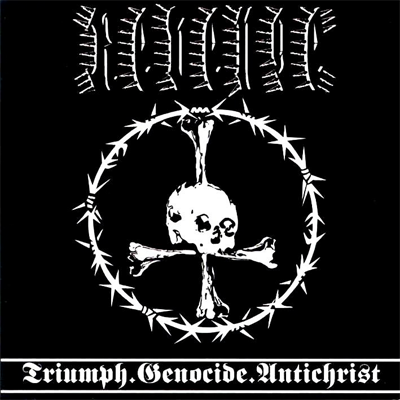
REVENGE, Triumph, Genocide, Antichrist  (2003, Osmose Productions)

The skull:
The leader of Revenge, James Read, is clearly a skull-worshipper. Another of his bands, Conqueror, is also enshrined in our Skullection (Skull155). And most Revenge releases feature a prominent skull doing something naughty, in the consistently uniform design that the band’s releases share. We won’t induct all of them, as the Council has a rule about such things, so it makes sense to go with the debut album. This cover design resembles the Conqueror album reviewed earlier in its bleak, spiky, barbed-wire, skully looking self. This little guy is encircled in barbed wire and seemingly mounted on King Diamond’s microphone holder. Cryptic and foreboding looking stuff.

The music:
Not that far away from Conqueror, actually, this album flies by in a hellish 31-minute smear. Totally gonzoid speed, equally apeshit vocals, bloodcurdling intensity everywhere…this is an exhausting listen, and while it’s fun for a few minutes, it gets old quick. And this from someone who can sit down and listen to Beherit, Nuclear Death and Sarcofago for hours. Yet Revenge is something else. It’s like that stuff, but 10 times more piercing, less organic, and just annoying. Maybe it’s the precision Angelcorpse-esque edge that turns me off (ie. boring after 5 minutes). It’s this monochromatic glaze that takes away any real vibrancy or attractiveness. Makes sense that Revenge sounds like Conqueror meets Angelcorpse, because Pete Helmkamp was a member of Revenge at this point. Crazy fuckers playing crazy music. Not for the faint of heart.
— Friar Wagner
SKULL216

LORD HAUNTED, Bang ‘Em Till Bleed the Bone  (2007, demo)

The skull:
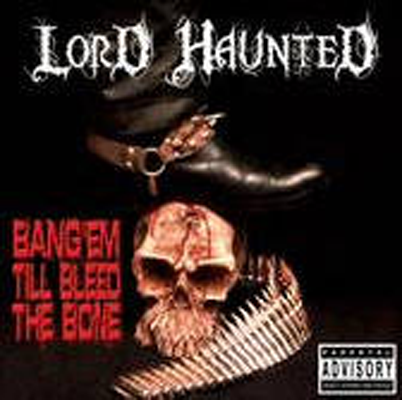
We have a winner here people. This prehistoric-looking skull appears to be a product of inbreeding. Just guessing. What an honor it must be, then, to be draped in a bullet belt and have a boot coming down on your head to try to, apparently, “bleed the bone.” And damned if the boot isn’t winning! We have here yet another demo band actually volunteering to place the parental advisory sticker on their album cover. (See also Skull210) It threatens to ruin everything, but this cover’s so awesome, not even that can diminish its greatness. So, till next time: bang ’em till bleed the bone and, uh, fist pump it till…um…till scrape the flesh.

The music:
The fact that Lord Haunted covers Manilla Road’s “Dig Me No Grave” should tell you all you need to know about their musical preferences. It’s an interesting cover choice, something from one of Manilla’s least-celebrated albums (The Courts of Chaos). The four other songs are all originals, and even if the cover art looks more like a dirty black/thrash kind of thing, this is pure epic traditional metal; none of these songs would have been out of place on any of those early Metal Massacre compilations. There’s an especially strong whiff of California’s Tyrant here, if that helps. When he’s in screaming mode, vocalist Marcos Fazzio often sounds uncannily similar to Artillery’s Flemming Ronsdorf, which is kinda cool, because you don’t hear that often. Lord Haunted is not bad, most the songs have a good bit of depth, lots of interesting parts, and the the dudes have the skills to pull it off. If the already-mentioned bands are your thing, as well as Omen, Helstar, Dio and Mercyful Fate, you could do worse. You won’t hear anything original either, but you probably weren’t expecting to.
— Friar Wagner

SKULL214

BLOODY SKIZZ, Gods Breaker / Bloody Road to Death  (1982, Belgravia)

The skull:
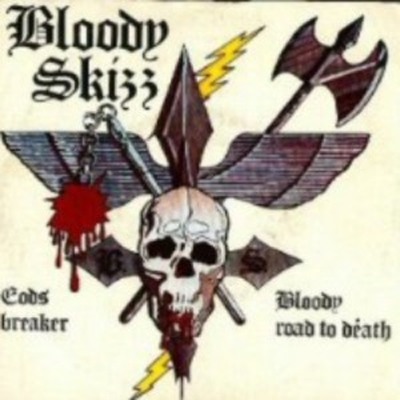
This skull is served with the works: an inverted crucifix, wings seemingly fashioned from metal or driftwood, an axe, a lightning bolt, and a mace that’s absolutely soaked in blood. The skull itself has seen better days — he looks concerned, and appears to have suffered a terrible accident, as he’s got blood pouring from his mouth. It could reasonably be assumed he was smashed in the teeth by the blood-soaked mace in the picture. It’s not an easy gig posing for these obscure European metal 7 inch picture sleeves!

The music:
Typical of much obscure Euro metal from the early ’80s, Bloody Skizz have a ton of heart, an enchanting rawness, an annoying vocalist, and not much that makes you want to return for seconds. The shambling “Gods Breaker” is clearly inspired by Iron Maiden and ends up sounding like Witch Cross before they found their muse with the Fit to Fight album. “Bloody Road to Death,” rather, is more influenced by Judas Priest. The vocals in this song are a very weak attempt at Rob Halford in the Hell Bent for Leather era. If it weren’t for the heavily-accented vocals, this could easily pass as a NWOBHM release. These two songs are all Bloody Skizz ever offered, and believe me, you can live without this…you’ll be fine.
–Friar Wagner

SKULL212

MERCY, King Doom  (1989, Euro)

The skull:
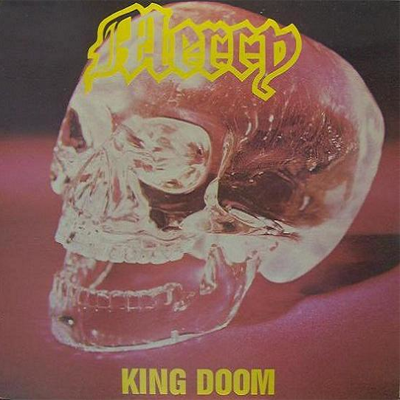
An observant reviewer on the Metal Archives site astutely notes that it’s hard to tell how big this skull is, because there’s nothing in the photo to use as scale. I’m gonna go with “planet-sized,” because I’d love to think that King Doom is the ruler of a planet shaped like a skull and made out of glass. This cover totally rules, and I’m not being funny or ironic. Its simplicity, and the pink, yellow and clear/glass colors have a kind of hypnotic, almost psychedelic effect on this friar. I am entranced. Almost obsessed.

The music:
The label that released this is Euro. What the hell is that? Research tells me the Euro label only released this album and one by long-forgotten Swedish band Captor in 1993. What a totally not-impressive discography! Anyway, Mercy are most famous for being the testing ground for one Messiah Marcolin, who went on to front Candlemass. By the time Mercy’s third album, King Doom, was released, Messiah was already nearing the end of his first campaign with Candlemass. So what does this album offer? A hollow production is the first aspect of note: opener “Death’s Company” features a decent plodding riff to open the ceremonies, and the guitar sound is a flat wash of treble, the bass is more or less implied rather than having any real presence, and the drums are thin with over-sizzly cymbals. The vocals — now we’re talking. This guy (Rick Wine) is crazy. He’s an off-the-chain yelper in the high register vein of Scott Jeffreys (Confessor) and John Stewart (Slauter Xstroyes). I like his delivery, there’s a lot of character in his wail, and a lot of control too. However, he doesn’t have much to work with, as the music is mostly faceless doom that rarely rises above the average. It’s one of those albums with a handful of enticing individual parts and riffs, but it’s not assembled very well and none of these songs are particularly memorable. A couple shorter instrumentals add some depth, and there are moments that nearly achieve greatness (album closer “Darkness,” for instance). Overall, though, it’s forgettable. No surprise, as Mercy was always second or even third-tier doom. I’ll continue to hold onto 1985’s Witchburner as the only Mercy album in my collection, and that due to it being an interesting historic relic. But man, this vocalist, hell yeah, I’m a fan.
–Friar Wagner

SKULL211

SATHANAS, Ripping Evil  (1988, demo)

The skull:
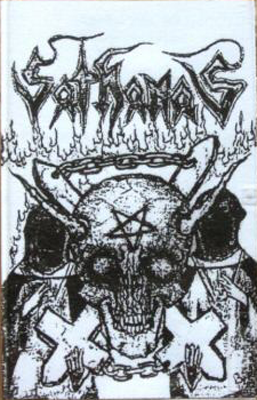
Yes! This is what we’re talking about! There is nothing left out here, nothing spared. Front and center is a skull whose forehead is branded with an upside down star. He looks fried and possessed by lunacy. That’s a fantastic start. He’s got horns that look like carrots. There are two cloaked figures flanking him (the Sunn dudes?), each holding a large inverted cross, the crosses chained together in satanic matrimony, crossed in an X behind the skull. They seem to be taking this job very seriously. Fire burns above the entire unholy scene. Ripping evil? Ripping evil what? Ripping evil a new asshole, I say! That makes no sense, of course, and neither does this tape cover. But it rules beyond all holy hell.

The music:
The fact that Pennsylvania’s Sathanas have been active since 1988 is something to respect. This is their very first demo, and it’s clearly influenced by Possessed, Mantas,
Hellhammer, Celtic Frost and possibly even Morbid Angel’s early material. They don’t
have the songwriting and/or playing skills and/or charm of those bands, so appeal is limited, but it’s still a document of the ’80s death metal movement, even if it is of minor importance. Ultimately each of these four songs is mediocre, but the crudeness and conviction with which it’s delivered is notable, and that it was released in the ’80s makes it a bit of a cool relic. Nothing more or less.
— Friar Wagner

SKULL210

RUDE FOREFATHERS, Corner of the Pain  (2004, demo)

The skull:
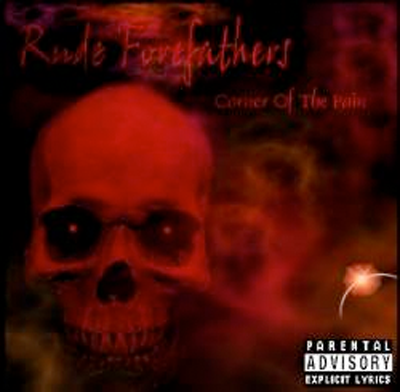
The eyes..the swirl of smoke…the nipple ring that glows for no apparent reason…the muddy red. This whole thing is an eyesore. Why not hammer that final nail into the coffin with the Parental Advistory warning? Surely many Italian parents must be forewarned that these Forefathers are not only Rude, but potentially Vile, Obscene, and maybe even a little bit Naughty. A silly cover that looks thrown together last minute. Where have we heard that before?

The music:
Although they now sound like post-Power Metal Pantera meets Children of Bodom, which means it’s very well-played but difficult to enjoy for this friar, this earlier Rude Forefathers material is much less accomplished. The riffs are plodding and ham-fisted, the vocals like pre-Focus Cynic (not a great thing actually)…and I’m not really sure what to call this kind of metal. It’s like some ’80s-era Brazilian death/thrash band, in terms of wacky production and shoddy performances, with a bit of a hardcore slant, and some doom elements thrown in. Ultimately, the’yre a traditional metal band influenced by the heavier varieties like death and thrash, without any real direction or interesting ideas. But I don’t hate this. It has a charm, and even some good moments: the intro riff and brief wah-wah craziness in “Firm Blood”; a crazed guitar line that reminds of John Weston-era Dawnbringer. But that’s as good as it gets. “Slave” is like Schizophrenia-era Sepultura playing a NWOBHM cover song. And “Depression”…well, it’s a horrible, horrible thing, starting ballad-like, moving into doomier territory and maxing out with a faster section. When it gets fast, they try tackling tricky technicality far beyond their abilities. The playing is junky, the vocals a punky embarrasment…the entire song sucks. Clearly a rip-off of Metallica’s trio of Side 1, Song 4 ballads circa 1984, 1986 and 1988. Rude Forefathers have improved remarkably since this well-intentioned demo, they’re much better players and songwriters now, but whether it’s this inept era of the band or the more professional current stuff, I have better things to do, I don’t have time for any of it.
— Friar Wagner

SKULL208

STATIC-X, Cannibal  (2006, Reprise)

The skull:
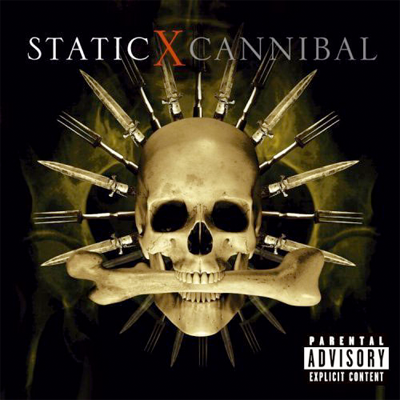
No crossbones for this skull — he just takes those bones and eats them. Like a cannibal! All that cutlery wreathed around his noggin are the tools of the trade he uses to get leg bone into mouth. Whatever works! Those choppers are in top-notch shape, too…they oughta be if they’re gonna be munchin’ bone. Kick ass cover (if you’re 14 years old), although it’s uglied up by that utterly stupid Parental Advisory warning.

The music:
Whether it’s super obscure Italian no-hopes or major label L.A. bands, very often a skull
album cover means “We love Pantera and Roots-era Sepultura.” Goes for Static-X too,
although there’s an added faux-industrial edge due to the use of electronics, samples,
and synth-generated beats. Whatever, it really sucks. I sat through this whole album hoping something interesting would happen. Nearly eight minutes into the album, a weird moment in “Behemoth” dips into the Buckethead-meets-Vai school of guitar work, but it’s brief, and these kinds of moments are rare throughout Cannibal. Any highlights seem to come in the area of the lead guitar work, as another of these rare bright moments comes in “Electric Pulse.” It’s very good actually, but, you know, “any port in a storm,” right? Quite often, Cannibal sounds like a melodic, nuanced Slipknot…a Slipknot-lite, maybe. I’m no metal purist that takes issue with any semi-metal band on a major label (see my Deftones review two skulls prior to this), but this is just dumb jockstrap metal. How does a band so vapid get so huge?
— Friar Wagner


SKULL206

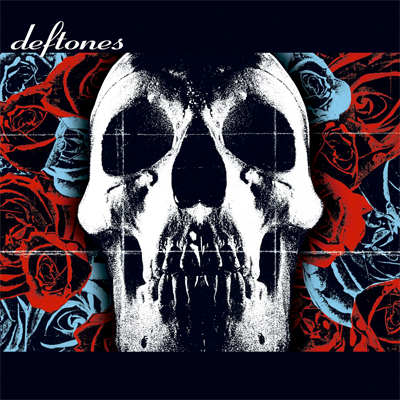
DEFTONES, Deftones  (2003, Maverick)

The skull:
Patriotic colors here, probably not intentional though. Red and blue roses flank each side of the skullface, his head slightly upward with an attitude that says “I don’t care about no stupid flowers, I am a bad ass skull!” No doubt he was pretty upset when the holder of this image folded it up nice and square and stuck it into the pocket that eventually produced the wear-lines you see on this image. Man, this skull is ready to fucking rock, and it’s surrounded by flowers and treated like a damn breakup note passed in 7th grade homeroom class? Skull says, “Bullshit, man…this is such bullshit.”

The music:
Are Deftones metal or not? Does it matter? The only reason it matters here at Big Dumb Skulls is because the Council requires that all entries be metal bands. And the Deftones are metal, they’re just other things too. I’m a huge fan, and the Council approved, so we’ll go with it. There are two main Deftones eras, to my ears: there’s the first two
albums, which skirts a nu-metal line without ever totally falling into it (they were more
often called “alternative metal” back then) and then the game-changing White Pony
and everything that came after. This is the band’s fourth album, self-titled for no good reason, and although it’s got some amazing moments, it’s the least-awesome album from Deftones Era 2. Coincidence that it’s got a skull on the cover? The only reason this album pales in any way to those around it is that a handful of songs, while very good as they’re rolling, don’t stick (such as “Battle-Axe” and “Bloody Cape”). But Deftones greatness is heard in the weirdly twisted “Hexagram,” and more viciousness (especially the seething vocals) in “When Girls Telephone Boys,” and the sumptuous atmospheric layers of “Moana” and “Deathblow.” It’s impossible not to feel moved by the somatic drift of “Anniversary of an Uninteresting Event.” And an all-time career highlight comes in the emotive “Minerva” while the weird experimentalism of “Lucky You” finds the band moving into new areas. Yeah, Deftones are way better than any nu metal band you care to name. The production is totally spot-on — colorful, thick, vibrant, earthy. It’s Terry Date, who has helmed some great records in and outside the metal realm. I just started liking this album even more with this listen, so go ahead, surprise yourself. I did when I first heard White Pony, and I will never call them a nu metal band again.
— Friar Wagner

SKULL204

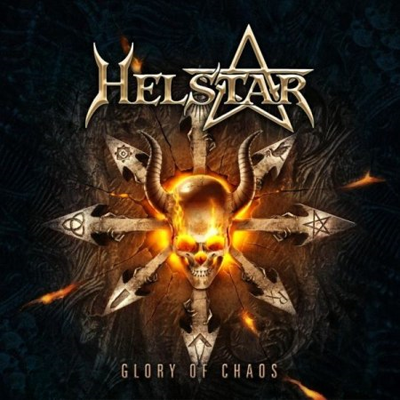
HELSTAR, Glory of Chaos  (2010, AFM)

The skull:
2010 was an amazingly prolific year for the big dumb skull. Scan through previous BDS reviews and you’ll see what I mean. It might just have been the best-ever year for skulls and, not coincidentally, was the year this friar’s collection of skull album covers grew exponentially. What does Helstar’s glorious chaos skull offer the Skullection? Not much, although it’s slightly worthy for the ominous, fiery glow that lights that sucker up like a Christmas tree. And then there’s the eight-pointed chaos symbol, its arrow tips sporting all kinds of symbols that probably amount to a lot of mystical malarky when you get right down to it (the RX sign for prescription medicine? Huh?). Anyway, I’m not sure where the glory is, and chaos is only implied by the symbol. Just another half-assed cover idea, I say.

The music:
Whoever thinks Helstar is better as a beefier, thicker, chunkier, faster, more modernized version of its old self is certifiably insane. They’re still “true” metal, and there’s still some great stuff to get out of this album and its predecessor, The King of Hell. James Rivera remains a vocalist of power, control and personality. And Helstar remains one of the best live bands going. I’ve seen them twice and was completely speechless afterwards. But here’s my problem with their new stuff: Glory of Chaos is to old Helstar what Painkiller is to ’70s era Priest. It’s good, but they’ve traded something precious away in dialing down their youthful naivete (Burning Star) and their sense of innovation and discovery (Nosferatu). There are no high or low points on Glory of Chaos, just one sturdy red line of near-thrash metal. “Trinity of Heresy” and “Deathtrap” could have been on A Distant Thunder, but they’re too bloated with down-tuned guitars, while “Monarch of Bloodshed” sounds like old men trying to be way heavier than what comes natural for them. Think Jugulator this time. But the production is throwing me off some. Everything’s way too up front, no real dynamics. It lacks the earthiness of their early stuff…then again I’m not going to sit here and tell you the guitar sound on Burning Star was great, because it wasn’t. You could do worse than listen to this album while the first four Helstar albums are also on your shelf, but for me, I’ll always choose any of those over this. Good luck to ’em, though, because in a perfect world they’d be as popular as Amon Amarth.
— Friar Wagner

SKULL202

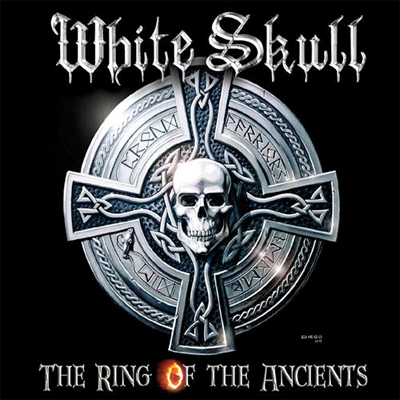
WHITE SKULL, The Ring of the Ancients  (2006, Frontiers)

The skull:
Standard issue stuff here, nothing to get excited about — not even enough here to make jokes about. Just a skull poised at the center of a forged-in-iron sigil that seems to mix elements of Irish and Norwegian folklore/mythology. The skull is just barely big enough to make it into these hallowed halls. Naturally we wish the skull were a lot bigger, but we’ll give it a pass. Probably one of the least remarkable skulls in the BDS Skullection…but wait till you see skull #203 — it’s one of the finest. If you want to, go ahead and use your imagination regarding a ring and the ancients who possess it, but you probably have better things to do.

The music:
The long-suffering White Skull (this is their seventh of nine albums so far) have never quite managed to rise above the morass of middling power metal bands that litter the European landscape. That’s because they’re mediocre. Musically, this album is full of decent performances, anthemic melodies, the requisite amount of Euro power metal speed, and a vocalist whose accent totally betrays their Italian origin. I certainly have nothing against Italian musicians, it’s just that their vocalists often sound a bit silly when grappling with English lyrics. What’s more, the riffs are totally assembly-line “true metal,” ones you’ve heard a zillion times already, unless you’re new to this stuff. And if that’s the case you could probably get something out of White Skull. The strongest element of The Ring of the Ancients are the several AOR-leaning moments. It’s not exactly in line with, say, the last couple Nocturnal Rites albums, but you can hear it occasionally, as in the pre-chorus break of “Ninth Night” and the subtlest corners of “From the Mist.” This partly answers why the album ended up on the Frontiers label. Oh, and they do a pretty decent cover of Black Sabbath’s “Valhalla.” Bonus points to them for choosing a song from Tony Martin-era Black Sabbath but, no real surprise, it’s ruined by the vocals.
— Friar Wagner